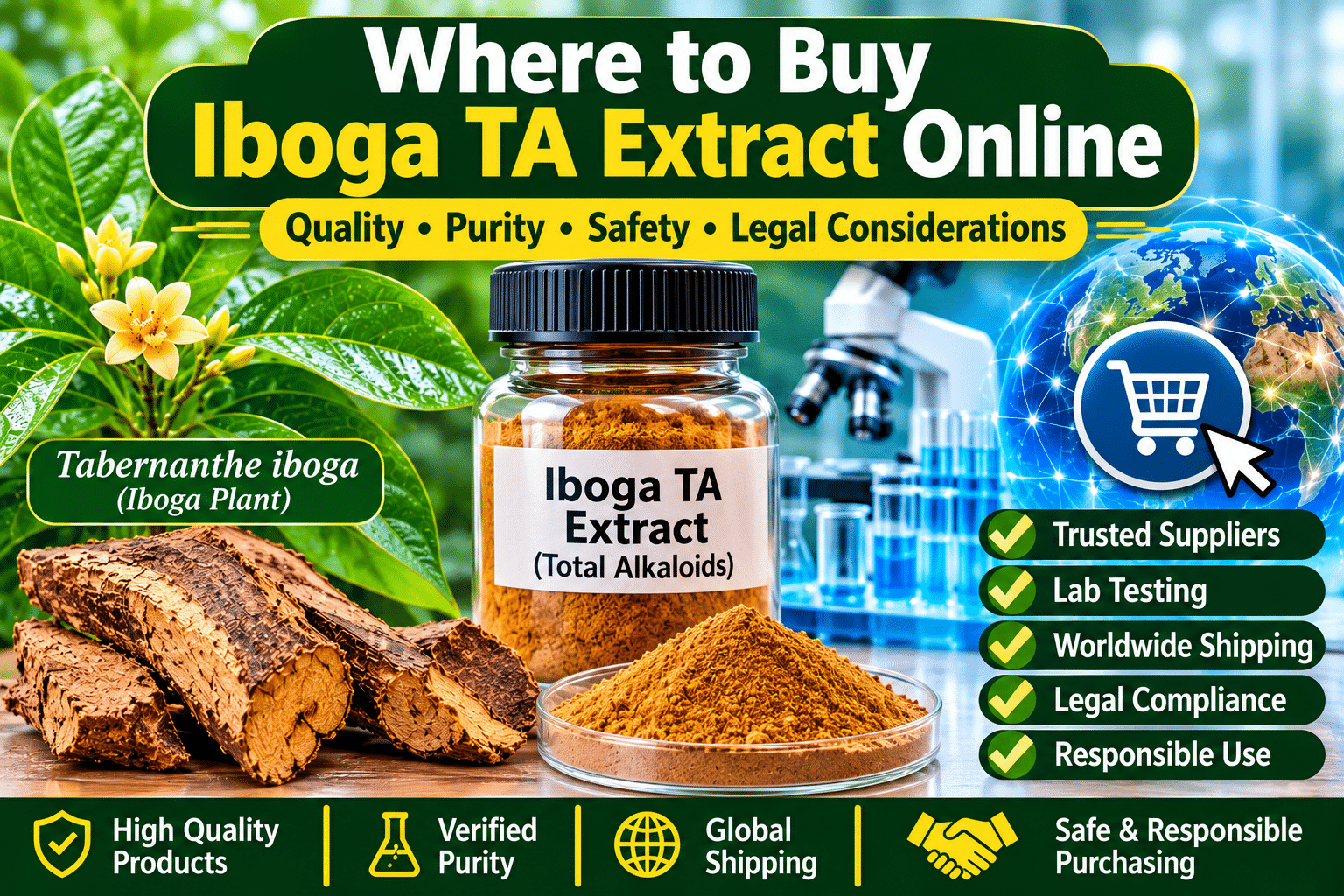
Where to Buy Iboga TA Extract Online: Quality, Purity and Important Considerations
Are you researching iboga TA extract online and trying to understand its composition, quality, and availability? With different iboga products and extract descriptions appearing across the internet, knowing what distinguishes Total Alkaloid (TA) extract from other iboga preparations is essential.
Iboga TA extract is derived from Tabernanthe iboga, a tropical plant native to Central Africa. The plant contains several naturally occurring alkaloids, including ibogaine, ibogaline, and ibogamine.
Interest in TA extracts has grown alongside scientific research into iboga’s complex chemical composition and pharmacological properties.
However, choosing an iboga preparation requires careful consideration of its chemical profile, laboratory documentation, legal status, and potential health risks.
This guide explains what iboga TA extract is, how it differs from ibogaine HCL, what laboratory testing can establish, and what to consider when researching online suppliers.
What Is Iboga TA Extract?
TA stands for Total Alkaloid. It describes an extract containing multiple alkaloids obtained from iboga plant material.
Unlike purified ibogaine hydrochloride, which is a more specifically defined chemical preparation, TA extract contains a broader mixture of naturally occurring alkaloids.
Its composition may include:
- Ibogaine.
- Ibogaline.
- Ibogamine.
- Other naturally occurring iboga alkaloids.
The proportions of these compounds can vary depending on the original plant material and extraction and processing methods.
Understanding Iboga TA Extract Composition
One important characteristic of TA extract is its complex alkaloid profile.
Unlike a single isolated compound, a total alkaloid preparation contains multiple chemical constituents.
When researching TA extracts, it is important to understand the difference between total alkaloid content and the concentration of individual alkaloids.
A product described as a total alkaloid extract does not automatically have a standardized chemical composition.
Independent laboratory analysis is necessary to establish what a particular sample contains.
Iboga TA Extract vs. Ibogaine HCL
Although both preparations originate from iboga, they have different chemical characteristics.
| Feature | Iboga TA Extract | Ibogaine HCL |
|---|---|---|
| Composition | Multiple alkaloids | Ibogaine hydrochloride |
| Chemical profile | Complex mixture | More specifically defined |
| Standardization | Depends on extraction | Depends on manufacturing |
| Testing | Alkaloid profiling | Identity and purity analysis |
| Origin | Iboga plant material | Ibogaine compound |
Neither preparation should be assumed safer or more effective based on its chemical composition alone.
Where to Buy Iboga TA Extract Online: What to Research
People searching for iboga TA extract online may encounter websites advertising different extract types and quality specifications.
However, online availability does not establish product authenticity, legal status, or medical safety.
Before relying on any supplier’s claims, investigate the following:
1. Independent laboratory analysis
Look for batch-specific laboratory documentation identifying the tested material and its chemical composition.
2. Alkaloid profiling
A useful analytical report should distinguish total alkaloid content from the individual alkaloids present.
3. Contaminant screening
Relevant testing may include heavy metals, residual solvents, and microbiological contaminants.
4. Product traceability
Documentation of botanical origin, manufacturing history, and batch identification helps establish accountability.
5. Legal compliance
Check applicable laws governing ibogaine and iboga-derived extracts in the country of origin and destination.
Do not rely on claims of unrestricted international availability or guaranteed customs clearance.
Why Laboratory Testing Matters
Laboratory testing is important because natural plant extracts can vary significantly in composition.
Depending on the sample, appropriate analytical techniques may include:
- High-performance liquid chromatography (HPLC).
- Liquid chromatography–mass spectrometry (LC-MS).
- Alkaloid identification and quantification.
- Residual solvent analysis.
- Heavy-metal screening.
A certificate of analysis should be specific to the tested batch and identify the laboratory responsible.
Importantly, laboratory verification establishes certain chemical characteristics; it does not demonstrate that an extract is medically safe.
International Regulations and Shipping Considerations
The legal status of iboga-derived extracts varies between countries.
Some jurisdictions impose restrictions on ibogaine, while others regulate particular products or their importation differently.
Important considerations include:
- Controlled-substance legislation.
- Import and export authorization.
- Customs documentation.
- Botanical import requirements.
- Applicable research or medical regulations.
Always verify the relevant legal requirements before considering an international transaction.
Important Health and Safety Considerations
Iboga TA extracts contain pharmacologically active alkaloids, potentially including ibogaine.
Ibogaine exposure has been associated with serious cardiovascular complications, particularly QT interval prolongation and potentially fatal cardiac arrhythmias.
Other potential complications include:
- Seizures.
- Dangerous medication interactions.
- Liver complications.
- Severe cardiovascular reactions.
The presence of multiple alkaloids does not guarantee a safer preparation.
Qualified medical assessment and appropriate clinical monitoring are essential considerations. Iboga products should not be used without qualified medical supervision.
Frequently Asked Questions
What does TA mean in iboga extract?
TA means Total Alkaloid. It describes an extract containing multiple naturally occurring alkaloids from the iboga plant.
What is the difference between TA and HCL?
TA contains a mixture of iboga alkaloids, whereas HCL refers to ibogaine hydrochloride, a more specifically defined chemical preparation.
How can iboga TA extract quality be verified?
Independent laboratory analysis can help establish alkaloid composition, chemical identity, and the presence of relevant contaminants.
Does every TA extract have the same composition?
No. Composition can vary depending on botanical source material and extraction and processing methods.
Can iboga TA extract be purchased internationally?
International availability depends on the applicable laws governing the product in both the exporting and importing countries.
Is iboga TA extract safe?
It cannot be considered inherently safe. Iboga alkaloids, including ibogaine, can cause serious and potentially fatal cardiovascular complications.
Final Thoughts
Understanding iboga TA extract requires more than comparing online product descriptions. Its botanical origins, alkaloid composition, laboratory documentation, and legal status all deserve careful consideration.
Although TA extracts contain a broader mixture of naturally occurring alkaloids than ibogaine HCL, this does not establish superior quality, effectiveness, or safety.
Anyone researching iboga TA extract should prioritize independent analytical evidence, legal compliance, responsible botanical sourcing, and qualified medical guidance.