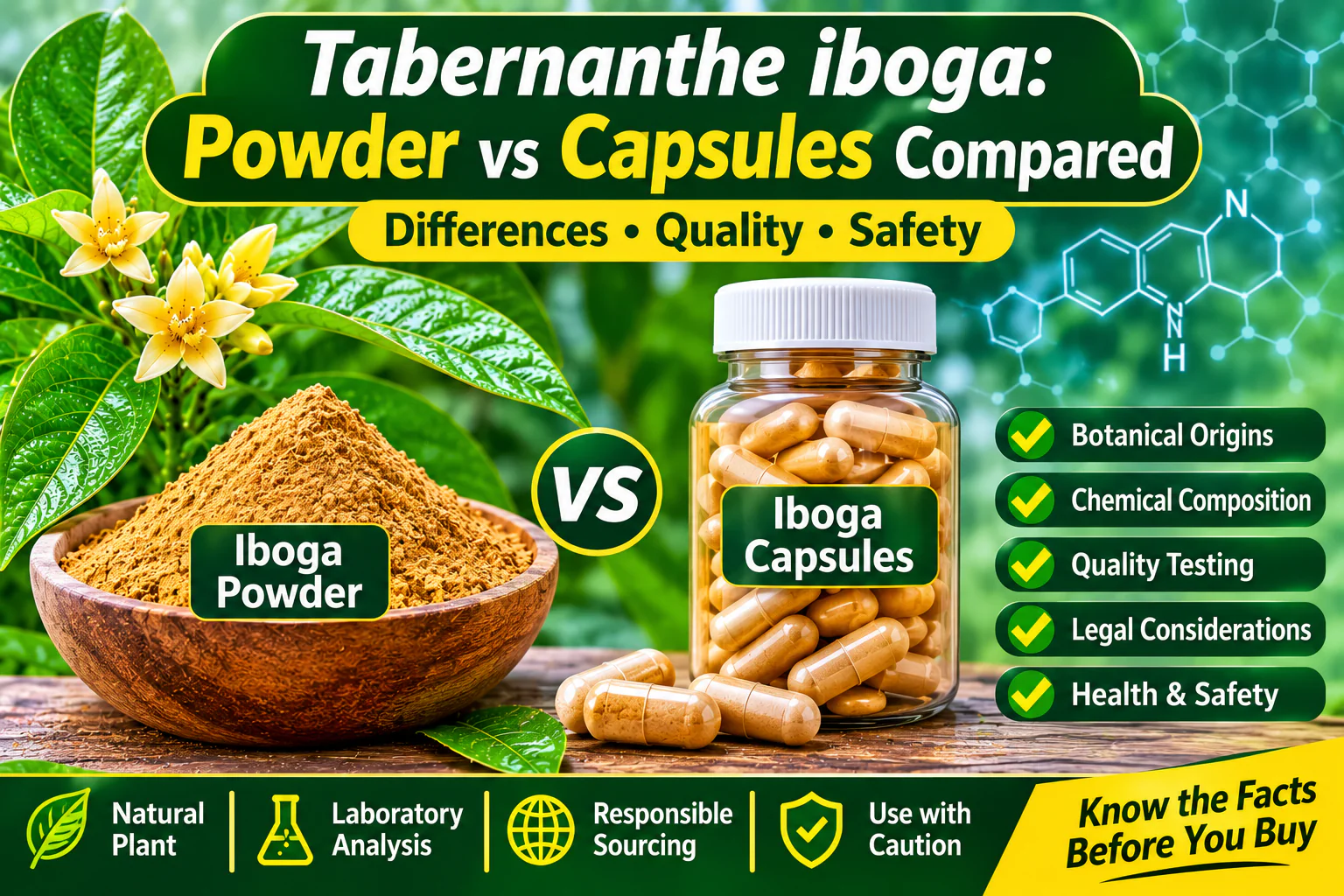
Tabernanthe Iboga: Powder vs Capsules Compared – Differences, Quality and Safety
Are you researching Tabernanthe iboga and wondering whether iboga powder or capsules are different? Understanding these two preparations can help you learn more about the plant, its natural alkaloids, product composition, and the importance of quality verification.
Tabernanthe iboga is a tropical evergreen shrub native to Central Africa, particularly Gabon. Its root bark has a long history of traditional and ceremonial use and contains several naturally occurring alkaloids, including ibogaine.
Today, iboga-derived materials are discussed in botanical research and scientific studies because of their complex chemical properties.
Powder and capsules are two forms commonly encountered in discussions of botanical preparations. Although they may contain similar plant material, their physical presentation, processing, packaging, and quality-control requirements can differ.
This guide compares iboga powder and capsules, explains their characteristics, and highlights important health and safety considerations.
What Is Tabernanthe Iboga?
Tabernanthe iboga is a plant belonging to the Apocynaceae family.
It grows naturally in parts of Central Africa and is particularly associated with traditional practices in Gabon.
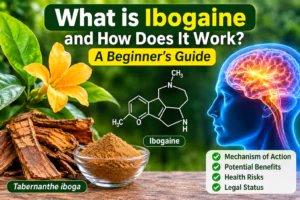
The plant contains several naturally occurring alkaloids, including:
- Ibogaine.
- Ibogaline.
- Ibogamine.
- Other related alkaloids.
The chemical composition of iboga material can vary depending on its botanical origin, growing conditions, harvesting, and processing.
What Is Iboga Powder?
Iboga powder generally refers to dried and ground iboga plant material, often derived from the root bark.
Unlike purified ibogaine HCL or total alkaloid extracts, botanical powder contains a broader mixture of naturally occurring plant constituents.
Its composition is not necessarily standardized.
Important quality considerations include:
- Botanical identity verification.
- Documented geographical origin.
- Alkaloid composition analysis.
- Contaminant screening.
- Heavy-metal testing.
- Microbiological quality assessment.
The appearance and color of botanical powder cannot reliably establish its chemical composition or potency.
What Are Iboga Capsules?
Iboga capsules are a prepared dosage form containing botanical material or an extract within a capsule shell.
The actual contents depend on the formulation and manufacturing process.
For example, capsules may contain:
- Ground botanical material.
- A processed botanical preparation.
- A concentrated plant extract.
These formulations are not chemically equivalent. The product description and independent laboratory documentation are necessary to establish what a particular capsule contains.
Capsule packaging also does not guarantee standardized alkaloid concentrations or medical safety.
Iboga Powder vs Capsules: Main Differences
The primary difference is their physical presentation and, potentially, their formulation.
| Feature | Iboga Powder | Iboga Capsules |
|---|---|---|
| Physical form | Loose botanical powder | Encapsulated material |
| Composition | Depends on source material | Depends on capsule contents |
| Processing | Drying and grinding may be involved | Additional formulation and encapsulation |
| Standardization | Not guaranteed | Not guaranteed |
| Quality verification | Botanical and chemical testing | Botanical, chemical and manufacturing testing |
| Safety | Significant risks | Significant risks |
Neither format should be considered inherently safer or more effective than the other.
Understanding Alkaloid Content
One of the most important considerations when studying iboga is its alkaloid composition.
Iboga contains multiple naturally occurring alkaloids, with ibogaine being one of the most extensively studied.
However, the concentration of individual alkaloids can vary significantly.
Laboratory techniques such as high-performance liquid chromatography (HPLC) and liquid chromatography–mass spectrometry (LC-MS) can help identify and quantify chemical constituents.
A certificate of analysis should identify the tested batch and the analytical methods used.
Importantly, a laboratory report showing chemical identity or purity does not establish that a preparation is medically safe.
Quality Considerations for Botanical Preparations
Whether researching loose powder or capsules, product quality requires more than attractive packaging or marketing descriptions.
Consider the following:
1. Botanical identification
Reliable botanical documentation helps establish that the material originates from the stated plant species.
2. Alkaloid analysis
Chemical testing can help establish the presence and concentration of relevant alkaloids.
3. Contaminant screening
Testing may include heavy metals, pesticides, residual solvents, and microbiological contaminants, depending on the preparation.
4. Manufacturing traceability
Batch identification and documented processing procedures help establish accountability.
5. Legal compliance
Ibogaine and iboga-derived preparations may be subject to restrictions depending on the country.
Traditional and Scientific Context
Iboga has significant cultural and historical importance in Central African communities.
Its traditional use should be understood within its cultural context rather than reduced to modern commercial product descriptions.
Scientific interest in ibogaine has also increased because of research into its interactions with neurological pathways.
However, ongoing scientific investigation should not be confused with established medical approval or proof of safety.
Important Health and Safety Considerations
Iboga contains pharmacologically active alkaloids, including ibogaine.
Ibogaine exposure can cause potentially life-threatening cardiovascular complications, particularly QT interval prolongation and dangerous heart rhythm disturbances.
Other reported complications include:
- Seizures.
- Serious medication interactions.
- Liver complications.
- Electrolyte abnormalities.
- Potentially fatal cardiac arrhythmias.
Natural botanical powder is not automatically safer than processed extracts or capsules.
Capsule packaging also does not eliminate the risks associated with iboga’s active alkaloids.
Iboga products should not be used without qualified medical assessment and appropriate clinical supervision.
Frequently Asked Questions
What is the difference between iboga powder and capsules?
Powder is a loose botanical preparation, while capsules contain botanical material or extracts enclosed in a capsule shell. Their actual chemical composition depends on their contents and processing.
Are iboga capsules made from natural root bark?
Some may contain ground root bark, while others may contain processed extracts. Product documentation is needed to establish the actual ingredients.
Does iboga powder contain ibogaine?
Iboga root material naturally contains ibogaine alongside other alkaloids, although concentrations vary between samples.
Are capsules more standardized than powder?
Not necessarily. Standardization requires documented manufacturing controls and appropriate laboratory testing.
Can iboga powder and capsules be considered safe?
Neither preparation can be considered inherently safe. Ibogaine can cause serious and potentially fatal cardiac complications.
How can iboga product quality be evaluated?
Independent botanical identification, chemical analysis, contaminant screening, and batch-specific documentation can help establish product characteristics.
Final Thoughts
Understanding the differences between Tabernanthe iboga powder and capsules is important when researching botanical preparations.
Powder and capsules differ primarily in physical form and potentially in formulation, but neither format guarantees standardized alkaloid content or improved safety.
The most important considerations are botanical identity, chemical composition, independent laboratory testing, legal compliance, and awareness of the potentially serious medical risks associated with ibogaine.
Responsible research should prioritize scientific evidence, respect for Central African botanical traditions, and qualified medical guidance.