
What Is Ibogaine and How Does It Work? A Beginner’s Guide
Introduction
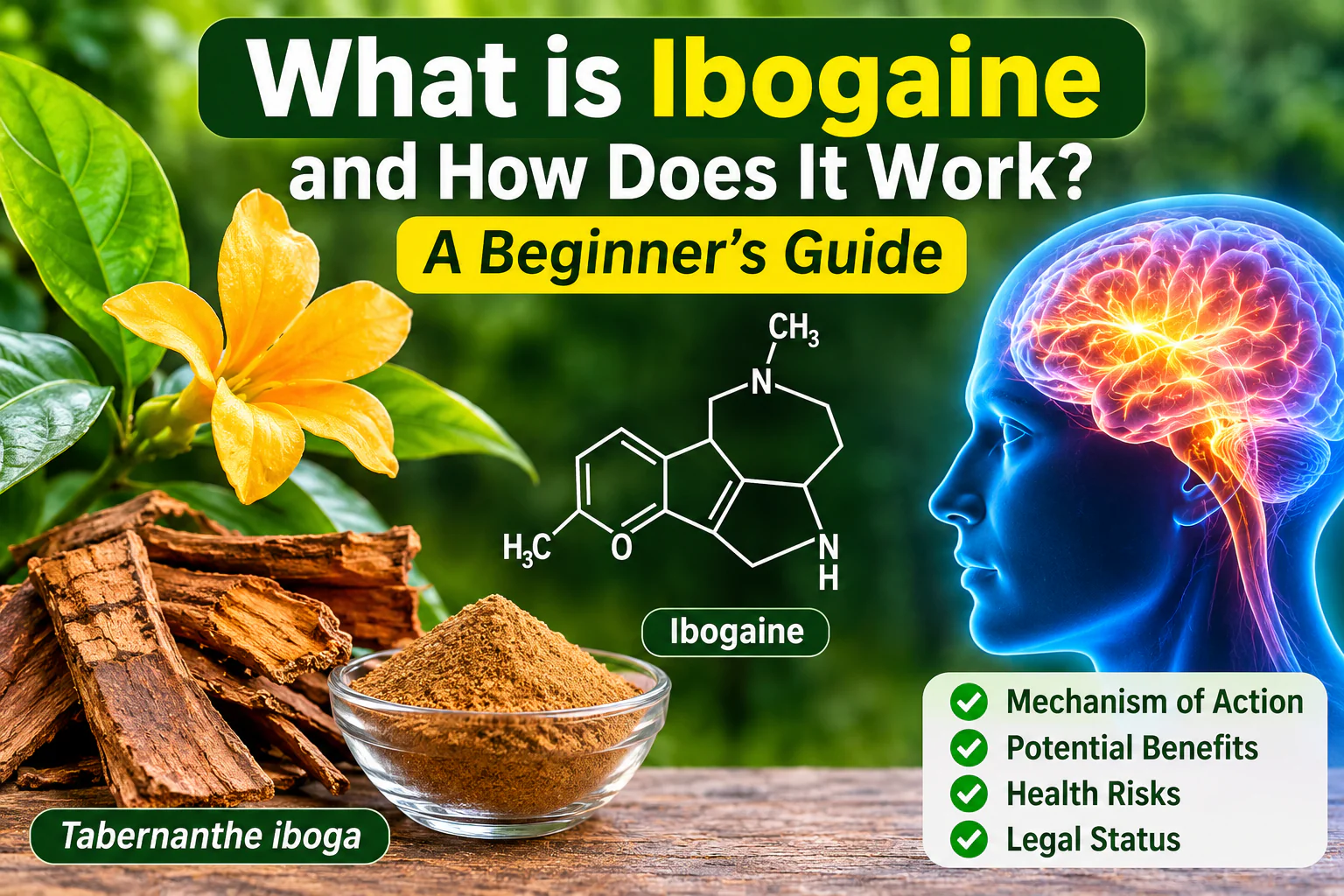
Ibogaine is a naturally occurring psychoactive alkaloid found in the roots of Tabernanthe iboga, a shrub native to Central Africa. The plant has a long history of traditional and ceremonial use, particularly in Gabon and surrounding regions.
In recent years, ibogaine has attracted international attention because of research into its possible effects on substance dependence, withdrawal symptoms, and brain chemistry. Scientists are investigating how it interacts with different neurotransmitter systems and why some people report changes in cravings after exposure.
However, ibogaine is a powerful substance with significant health risks. Its potential therapeutic applications are still being investigated, and it is not an established or risk-free treatment for addiction.
This guide explains what ibogaine is, how it works, what researchers are studying, and what beginners should understand about its safety.
1. What Is Ibogaine?
Ibogaine is an indole alkaloid naturally found in Tabernanthe iboga. It is one of several chemical compounds present in the plant’s roots and root bark.
Unlike many medicines that primarily affect one biological target, ibogaine interacts with multiple systems in the central nervous system. These interactions may influence mood, perception, motivation, reward, and other brain functions.
After entering the body, ibogaine is metabolized by the liver into another active compound called noribogaine. This metabolite may contribute to some of the longer-lasting effects associated with ibogaine exposure.
Ibogaine should not be confused with the iboga plant itself. Iboga refers to the botanical material, while ibogaine is one specific alkaloid found within it.
2. How Does Ibogaine Work in the Brain?
The exact mechanism of action of ibogaine is not fully understood. Research suggests that it affects several neurotransmitter systems involved in communication between brain cells.
Interaction with opioid receptors
Opioid receptors help regulate pain, reward, stress, and other functions.
Ibogaine and noribogaine interact with opioid receptor pathways. Researchers are investigating whether these interactions help explain reports of reduced opioid cravings or changes in withdrawal experiences.
However, the precise role of these receptors in ibogaine’s effects remains uncertain.
Effects on dopamine
Dopamine is a neurotransmitter involved in motivation, reward, learning, and reinforcement.
Ibogaine can affect dopamine transport and signaling. Since dopamine pathways are involved in substance-related behaviors, scientists are studying whether these effects may help explain some of the changes reported in addiction research.
Effects on serotonin
Serotonin plays an important role in mood, sleep, appetite, and perception.
Ibogaine and noribogaine interact with serotonin-related pathways. These effects may contribute to some of the psychological and perceptual changes associated with ibogaine.
Interaction with glutamate and NMDA receptors
Glutamate is one of the brain’s primary excitatory neurotransmitters. NMDA receptors are involved in learning, memory, and communication between neurons.
Ibogaine has demonstrated activity at NMDA receptor systems. Researchers are studying how this interaction may contribute to its broader effects on brain activity.
Possible effects on neuroplasticity
Neuroplasticity is the brain’s ability to adapt and reorganize its connections.
Preclinical studies suggest that ibogaine-related compounds may influence signaling pathways involving proteins such as brain-derived neurotrophic factor (BDNF) and glial cell line-derived neurotrophic factor (GDNF).
These proteins are associated with neuronal health and plasticity. However, laboratory findings do not prove that ibogaine repairs the human brain or produces lasting recovery from addiction.
3. What Is Noribogaine?
Noribogaine is an active metabolite produced when the liver processes ibogaine.
An enzyme called CYP2D6 plays an important role in this metabolic process. Differences in CYP2D6 activity can affect how individuals process ibogaine.
Noribogaine has its own pharmacological activity and may remain in the body longer than ibogaine. This is one reason why the effects and duration of exposure can vary between individuals.
Other medications and individual health factors may also influence metabolism and potential risks.
4. Why Is Ibogaine Being Studied for Addiction?
One of the main reasons for growing scientific interest in ibogaine is its possible relationship with substance-use disorders.
Researchers have investigated its potential effects in people experiencing problems involving:
- Opioids
- Cocaine
- Stimulants
- Alcohol
- Other substances associated with dependence
Some observational reports describe reductions in cravings or withdrawal symptoms after ibogaine exposure. These reports have encouraged further investigation into its effects on reward pathways and brain signaling.
However, early observations are not the same as proof of treatment effectiveness. Much of the available human evidence comes from case reports, observational studies, and relatively small investigations.
Larger, carefully controlled clinical trials are needed to determine whether ibogaine has a reliable therapeutic role.
5. What Effects Can Ibogaine Produce?
Ibogaine can produce significant physical, psychological, and perceptual effects. Experiences vary between individuals and cannot be reliably predicted.
Reported effects include:
- Changes in visual perception
- Vivid dream-like experiences
- Intense introspection
- Altered perception of time
- Nausea and vomiting
- Dizziness and difficulty coordinating movement
- Anxiety or confusion
- Changes in heart rhythm
Some individuals describe emotionally intense experiences, but personal accounts do not establish a predictable medical benefit.
The duration and intensity of effects can also be difficult to anticipate.
6. What Are the Health Risks of Ibogaine?
Understanding ibogaine requires looking at its potential risks as well as its proposed benefits.
Cardiac complications
The most serious known concern is ibogaine’s effect on the heart’s electrical activity.
Ibogaine can prolong the QT interval, which represents part of the heart’s electrical recovery cycle. Significant QT prolongation can contribute to dangerous heart rhythm disturbances, including torsades de pointes.
These complications can become life-threatening, and fatal cases have been reported.
Neurological effects
Reported neurological effects include dizziness, confusion, tremors, poor coordination, changes in perception, and seizures in some adverse-event reports.
Gastrointestinal effects
Nausea and vomiting are frequently reported. Severe vomiting can contribute to dehydration and electrolyte disturbances, which may further increase health risks.
Medication interactions
Other medicines and substances can affect ibogaine metabolism or increase the risk of adverse reactions. Interactions are particularly important because some medications also influence heart rhythm.
Why medical supervision matters
Ibogaine should not be treated as an ordinary herbal supplement. Its potential cardiac complications make professional medical assessment and appropriate monitoring essential in any clinical investigation or treatment involving the substance.
An online dosage guide, product description, laboratory certificate, or informal supervision arrangement cannot guarantee safety.
7. Ibogaine vs. Iboga Root Bark vs. Iboga TA Extract
These terms describe different forms of iboga-related material.
| Form | Description |
|---|---|
| Iboga root bark | Botanical material containing multiple naturally occurring alkaloids |
| Iboga TA extract | A total-alkaloid preparation containing several iboga alkaloids |
| Ibogaine HCL | A hydrochloride salt of ibogaine, a more specifically defined chemical form |
These preparations are not interchangeable. Their chemical composition and concentration may differ, and the quality of a particular sample cannot be established from its name or appearance alone.
Laboratory testing can help identify chemical composition, but it does not remove the health risks associated with ibogaine.
8. Is Ibogaine Legal?
The legal status of ibogaine and iboga-related products varies between countries.
Some jurisdictions restrict ibogaine as a controlled substance, while others regulate it differently or have specific rules concerning possession, supply, research, and medical use.
Anyone researching ibogaine should consult current official regulations in their country before making decisions involving the substance.
An online advertisement or offer of international delivery does not establish that possession, importation, or use is lawful.
9. What Does Current Ibogaine Research Tell Us?
Scientific research into ibogaine continues, particularly in addiction neuroscience and the development of compounds inspired by its chemical structure.
Researchers are investigating:
- How ibogaine and noribogaine interact with neurotransmitter systems
- Whether changes in brain signaling help explain reported effects on cravings
- How individual metabolism influences exposure and adverse effects
- Why ibogaine can affect cardiac electrical activity
- Whether related compounds could retain potential therapeutic effects with fewer safety concerns
Although these research questions are important, significant uncertainties remain. More rigorous clinical studies are necessary before ibogaine’s effectiveness and appropriate medical role can be established.
10. Frequently Asked Questions
What is ibogaine in simple terms?
Ibogaine is a naturally occurring psychoactive alkaloid found in the roots of the African shrub Tabernanthe iboga. It affects multiple brain signaling systems and is being researched for possible applications in substance-use disorders.
How does ibogaine work?
Ibogaine interacts with several neurotransmitter systems, including opioid, dopamine, serotonin, glutamate, and nicotinic acetylcholine pathways. Its complete mechanism of action is still being investigated.
Is ibogaine the same as iboga?
No. Iboga is the plant, while ibogaine is one of the psychoactive alkaloids found in it.
What is noribogaine?
Noribogaine is an active metabolite produced when the body processes ibogaine. It has its own pharmacological effects and may contribute to the longer-lasting effects of exposure.
Is ibogaine a proven addiction treatment?
No. Early research and observational reports have identified possible benefits, but the evidence is not sufficient to establish ibogaine as a proven or routinely recommended addiction treatment.
Can ibogaine affect the heart?
Yes. Ibogaine can prolong the QT interval and has been associated with dangerous ventricular arrhythmias and fatalities. Cardiac risk is one of the most important limitations in its clinical development.
Is ibogaine safe for beginners?
There is no established safe beginner-use protocol. Its effects can be unpredictable, and serious cardiac complications have been reported. Self-administration is not recommended.
Conclusion
Ibogaine is a complex psychoactive alkaloid derived from Tabernanthe iboga. It has attracted scientific interest because it interacts with several neurotransmitter systems involved in reward, motivation, perception, and substance dependence.
Its possible applications in addiction research remain under investigation. However, the evidence is still developing, and potentially life-threatening cardiac complications are a major safety concern.
Understanding what ibogaine is and how it works means considering its pharmacology, possible therapeutic applications, legal status, and health risks—not just its traditional history or reported effects.
Medical disclaimer: This article is for educational purposes only. It does not recommend ibogaine use, provide dosing instructions, or replace professional medical advice. Anyone seeking help for substance-use problems should consult qualified healthcare professionals about evidence-based treatment options.


[…] Stem, trunk, or root bark […]